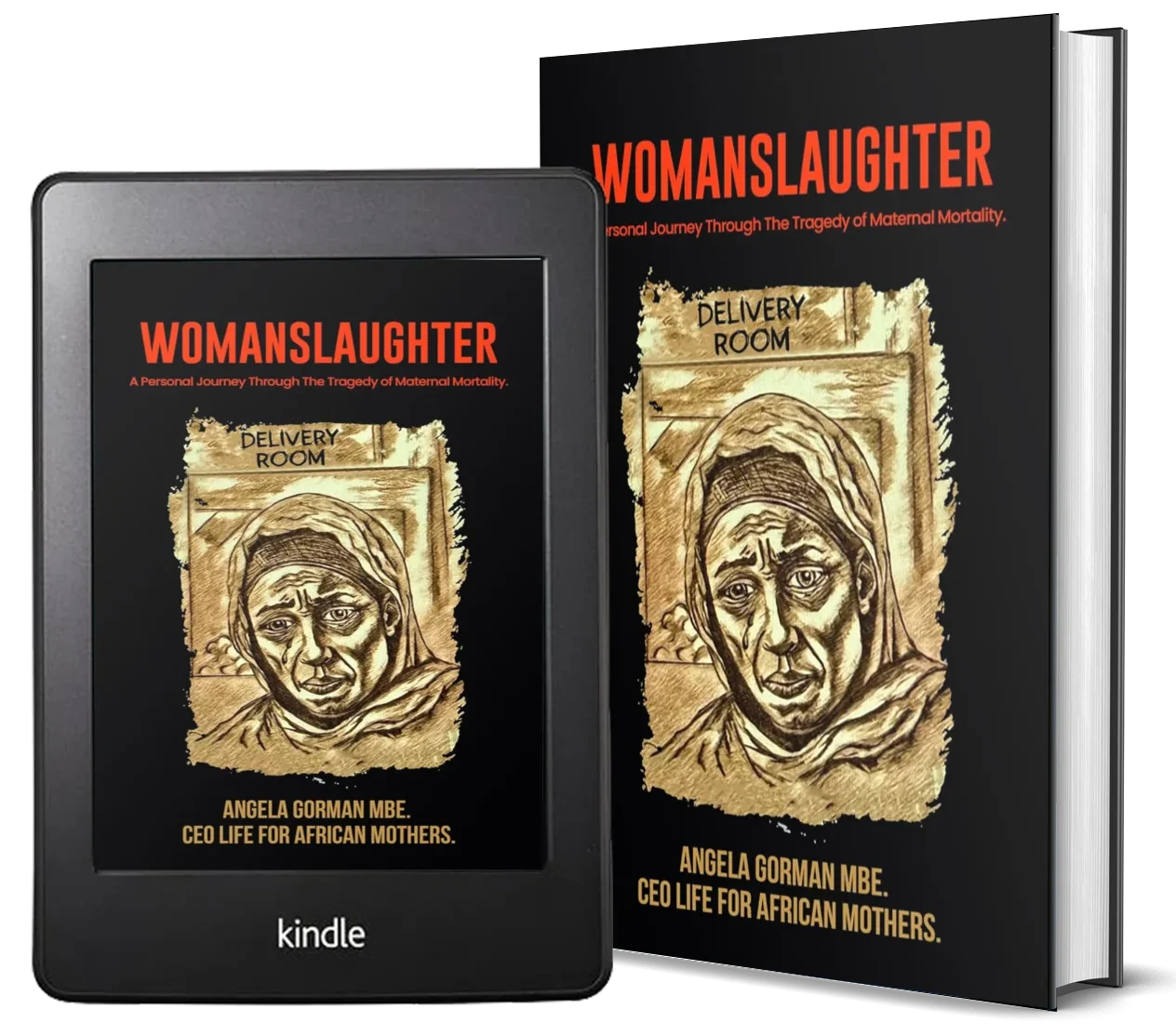
Conversations about women’s health often focus on access, equality, reproductive care, medical research and healthcare systems. Yet one issue still demands far more attention: maternal mortality. Angela Gorman, MBE, brings that issue into sharp human focus in WOMANSLAUGHTER: A Personal Journey Through The Tragedy of Maternal Mortality.
Her story matters because it does more than present statistics. It shows what maternal mortality looks like through the eyes of someone who spent decades caring for babies, travelling into under-resourced healthcare settings and working directly with the people trying to keep mothers alive.
It Begins With One Moment of Awareness
Gorman’s journey changed dramatically in June 2005. At the time, she was 57 and working as a senior neonatal intensive care nurse in Cardiff. After an exhausting day, she nearly switched off the television before watching the BBC Panorama documentary Dead Mums Don’t Cry.
The programme followed Dr. Grace Kodindo in Chad and showed women and girls dying from complications of pregnancy and childbirth. Gorman was deeply affected because many of the treatments needed to save those lives were familiar to her from the UK healthcare system.
Instead of simply feeling upset, she wrote an email that night asking how she could help. That decision became the starting point of a humanitarian mission that would continue for roughly two decades.
Her Story Makes Maternal Mortality Personal
One of the strengths of WOMANSLAUGHTER is that it refuses to reduce maternal mortality to numbers alone.
Gorman writes about women giving birth in hospitals with severe shortages of medication, equipment, electricity, gloves and basic supplies. She describes seeing staff work under conditions that would be almost impossible to imagine in well-resourced healthcare systems.
She also saw what happened when the necessary treatment was available. During her first visit to Chad, donated antibiotics allowed a woman suffering from a severe infection to receive a complete course of treatment without having to pay for it. The woman survived.
That single story captures one of the book’s central messages: sometimes the difference between life and death is not medical knowledge, but access.
The Scale of the Work Is Difficult to Ignore
What began with an effort to support one hospital eventually developed into Life for African Mothers.
According to Gorman’s account, the organisation supplied more than six million Misoprostol tablets across parts or all of seven countries over approximately 20 years. She estimates that around two million women received the medication free of charge.
Those figures matter, but so does the larger question behind them: why should lifesaving maternal healthcare depend so heavily on where a woman happens to be born?
Her Mission Is Also a Family Story
Perhaps the most powerful part of Gorman’s journey is the discovery that her advocacy was connected to her own family history.
Her paternal grandmother, Hannah Granville, died in 1915. When Gorman later obtained her death certificate, she discovered that catastrophic postpartum haemorrhage was listed as a cause of death.
It was the same condition she had spent years helping other women survive.
That connection transforms WOMANSLAUGHTER from a humanitarian memoir into something even more personal: a story about generations, loss, purpose and the possibility of turning tragedy into action.
Angela Gorman’s story deserves a place in the global conversation about women’s health because it asks readers not only to care, but to question why preventable maternal deaths continue.
WOMANSLAUGHTER is a reminder that women’s health is not an abstract policy issue. It is about mothers, children, families and whether lifesaving care is available when it is needed most.
Read WOMANSLAUGHTER: A Personal Journey Through The Tragedy of Maternal Mortality by Angela Gorman, MBE: https://www.amazon.com/dp/B0H8FKFQBZ