Why do women still die from complications that modern medicine already knows how to treat?
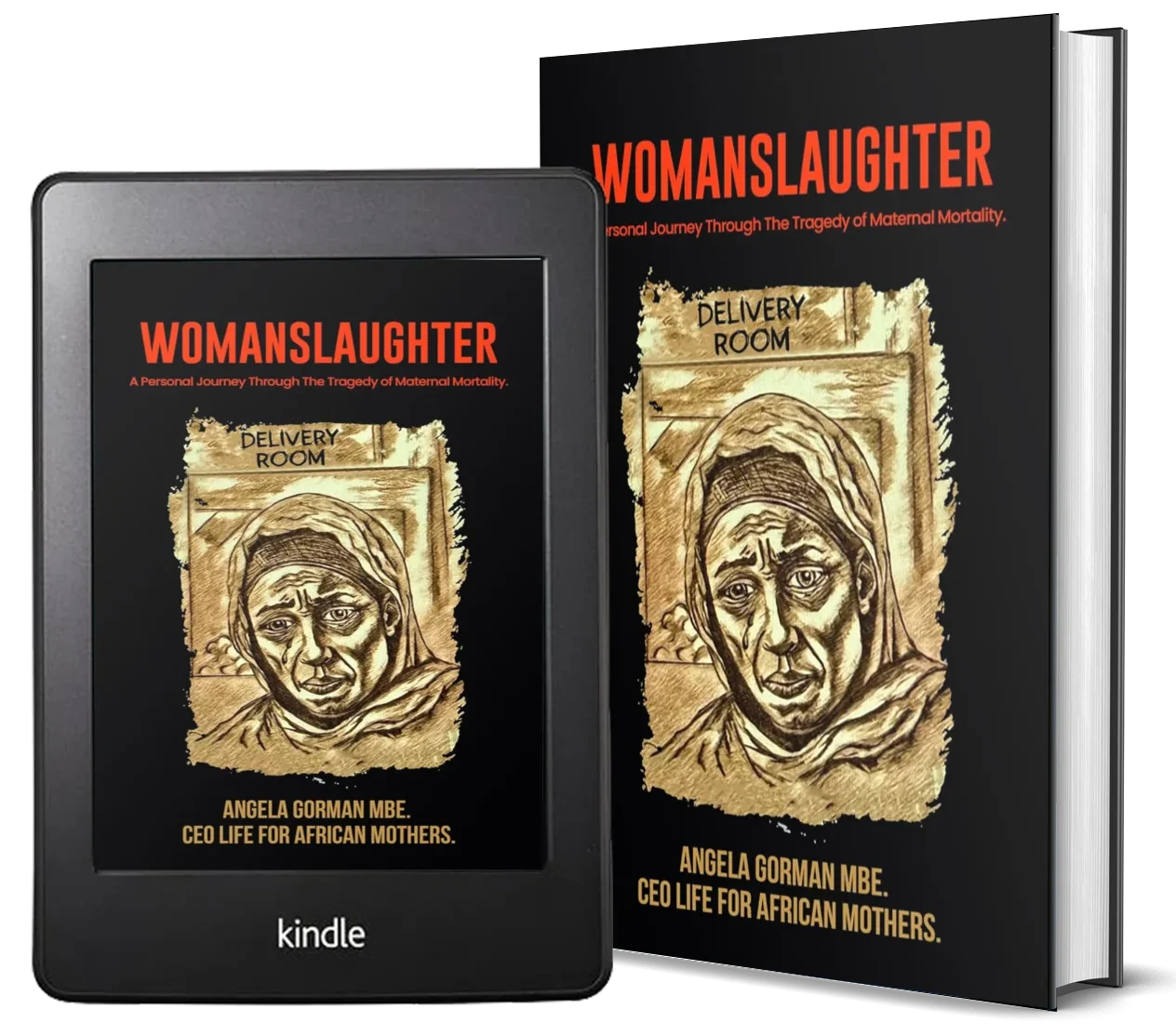
That question runs through WOMANSLAUGHTER: A Personal Journey Through The Tragedy of Maternal Mortality by Angela Gorman, MBE. Her book is not built around distant statistics alone. It is shaped by the mothers, babies, doctors, midwives, hospitals and communities she encountered during roughly two decades of work focused on maternal and newborn survival.
For Gorman, the issue became impossible to ignore in June 2005.
The Moment Everything Changed
At the time, Gorman was 57 and working as a senior neonatal intensive care nurse in Cardiff. One evening, after an exhausting shift, she watched the BBC Panorama documentary Dead Mums Don’t Cry. The programme followed Dr. Grace Kodindo in Chad and showed women and girls dying from complications of pregnancy and childbirth.
What struck Gorman was not only the suffering. It was the preventability.
She saw patients losing their lives because medications and resources routinely available in richer healthcare systems were not available to them.
When Dr. Kodindo spoke about losing multiple women in only a few days, Gorman reached a point where watching was no longer enough. She opened her laptop and wrote an email asking what she could do to help.
That decision became the beginning of an entirely new chapter in her life.
When the Treatment Exists but Access Does Not
One of the most disturbing themes in WOMANSLAUGHTER is that many maternal deaths are not caused by mysterious or untreatable conditions.
The problem can be painfully simple: a hospital does not have the medicine, the equipment, the electricity, the blood supply or the clinical resources needed at the critical moment.
Gorman saw this firsthand.
During her first visit to Chad, she encountered a woman who had developed a severe infection after an unsafe abortion. Her family could only afford one day of antibiotics. Fortunately, a shipment supported by Gorman’s group had arrived, allowing the woman to receive a complete course of treatment free of charge. She survived.
That experience exposed a painful reality: sometimes survival depends not on whether medicine exists, but on whether someone can access it.
The Question Gorman Keeps Asking
Throughout her work, Gorman repeatedly challenged audiences with a deliberately uncomfortable comparison.
If hundreds of thousands of men were dying every year from largely preventable conditions, would the world accept it with the same level of urgency?
In the book’s conclusion, she recalls asking this question again and again and receiving the same response: people generally believe far more would be done.
That is where the title WOMANSLAUGHTER gains much of its force. The book asks readers to confront not only maternal mortality itself, but also the social and political willingness to tolerate preventable female deaths on such a scale.
Turning Outrage Into Action
Gorman did not stop at asking questions.
Her work through Life for African Mothers grew from supporting one hospital into a much broader effort. She records that the organisation supplied more than six million Misoprostol tablets across parts or all of seven countries, with around two million women receiving the medication free of charge.
Yet WOMANSLAUGHTER never presents the issue as solved.
Instead, it asks readers to reconsider what society accepts as inevitable.
Maternal mortality is not simply a women’s health statistic. Every maternal death can reshape a family, affect children’s survival and education and leave consequences that continue for generations.
That is why Angela Gorman’s question matters.
If the deaths are preventable, why are they still being accepted?
Read WOMANSLAUGHTER: A Personal Journey Through The Tragedy of Maternal Mortality by Angela Gorman, MBE: https://www.amazon.com/dp/B0H8FKFQBZ